
Gimme some PDA
No, not that sort. PDA also stands for Pre-demolition Audit - a skip-swerving concept that's gaining traction in commercial projects. But could it work at home?


For every five houses built, one house-worth of material goes to landfill or incineration.
Imagine a world where: you’re doing up your bathroom, extending or having a new kitchen, but before your plans get set in stone (or concrete) someone comes round to do a survey in which they assess everything you’ve already got that can be reused, potentially saving you money - and definitely reducing the contents of your skip.
As someone who once asked builders to save our old kitchen and reuse it to create a utility room, then came home to find it smashed up in the skip, this is a service I dream of.
Whether a stand-alone surveyor, an interior designer or your architect, they’d work closely with your builders and incorporate these items – from furniture and lighting to construction materials and fixtures – into the project from the outset. There would be no chin rubs from the builder, saying, “That’s not how I usually do this” or “but it’ll only cost you £1000 more to rip it all out and do it all new”. You’d have an expert backing you up and a spreadsheet to clarify all the savings you’ll be making balanced against the cost of, say, additional labour. Suggestions, coming from a building expert, would also be feasible.
Architects or interior designers doing this job could also suggest alternatives to demolition if you’ve got a rear extension in mind. Clever design can often create surprising spatial opportunities that bypass knocking things down, which not only creates waste but also carbon emissions. It’d also be a major chunk of your budget back in the pot.
In a brilliant webinar organised by Reusefully and part of last year’s Circular Economy Week, one of the speakers mentioned a statistic I’d not heard before, but which didn’t surprise me: that, for every five houses built, one house-worth of material goes to landfill or incineration. The source is the sustainable architect, Duncan Baker-Brown of Baker Brown Studio, whose quote came up in the Q&A at the end. Baker-Brown designed The Waste House, a house made from 85% “so-called ‘waste’ material” drawn from household and construction sites (a project I’ll definitely be returning to). It’s a sobering thought, right?
The average lifespan of an office block is 50 years, during which it is likely to have 10 full refits. Historically, each strip-out has gone into skips.
On a more positive note, the webinar also reminded me of the other meaning of PDA: pre-demolition audit. These surveys are something increasingly happening in commercial buildings and are something I knew about in theory: an expert goes into a building to - TA-DA! - assess what can be salvaged and reused and how. But I was fascinated to learn more about how they work in practice: how everything from light fittings flooring, desks, seating to glass panels get assessed, with professional advice on how each item can be either reused, repurposed or repaired for use on site, or where it could otherwise be rehomed for use on other projects.
It’s great that PDAs are more common in the world of commercial buildings - for example, the average lifespan of an office block is 50 years, during which it is likely to have 10 full refits. Historically, each strip-out has gone into skips. Things are evolving.
Aside from PDAs, other exciting initiatives discussed, and which are already growing, include pre-used materials banks and large-scale reuse and re-certification of lighting. These ideas are gaining traction commercially because there are networks of surveyors, architects and contractors, and some were also part of the webinar, who are talking to each other and facilitating the movement of materials between projects without the need for storage (the million-dollar conundrum when it comes to reuse - because if there’s nowhere for those 500 reusable light fittings to be moved to…).
There’s still a long way to go, of course, but not as far as there is with residential interiors where PDAs aren’t really a thing. This is largely because a one-off project has totally different logistics and the small scale, relatively, can appear to make reuse expensive - especially if it involved hiring a specialist surveyor, as is the case in commercial projects.
But so many architects and interior designers have told me the extra expense of reconfiguring what’s there and working with salvage - which can take more labour time and involve unfamiliar skills or materials - tends to balanced out by savings made on buying less or buying not new.
Could PDAs for our homes become a reality? (Maybe rebranded as a “PRA” - pre-renovation audit.)
Well, the good news is that some designers and architects are increasingly taking on this job. But if you’ve got your heart set on that bathroom you saw on Pinterest or the sofa in someone’s beautiful house on Instagram, would you be game? Here are three examples that might inspire.
The not-new new kitchen
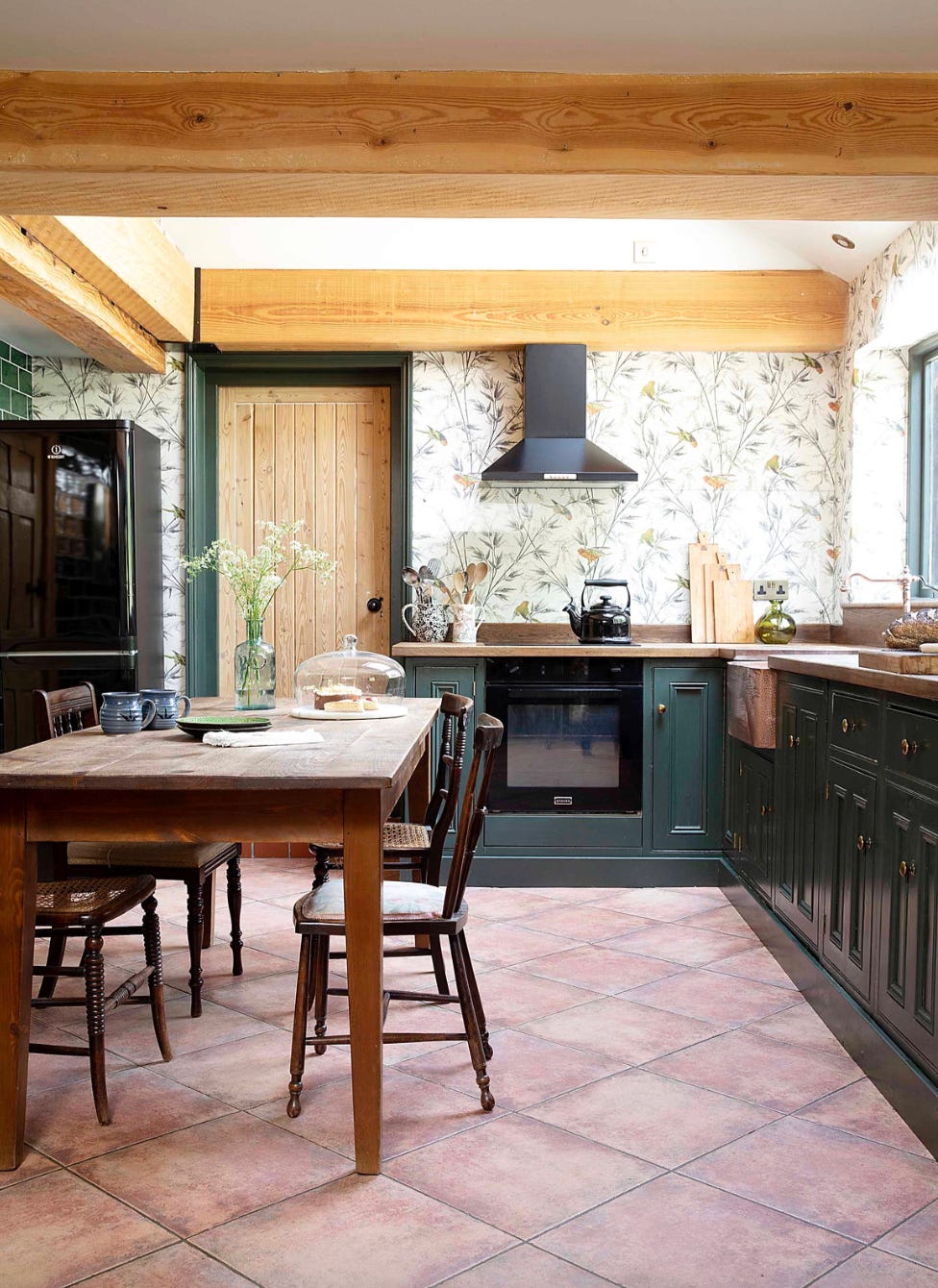
A couple of weeks ago I wrote about a brilliant example of kitchen reuse. Here’s a very different one: I interviewed interior designer Karen Knox of Making Spaces, in Leeds, about this beautiful project she calls The Victorian Cottage, back when I was working at Houzz.
Low waste was less a sustainability aim, more a knock-on: the owners just didn’t have the budget for a new kitchen, but wanted a new kitchen. But it’s a great example of how mindset and design experience can pull of something that definitely doesn’t look second best.
This is how it looked before; perfectly nice but not quite the owners’ style aesthetically, plus the layout wasn’t working for them.
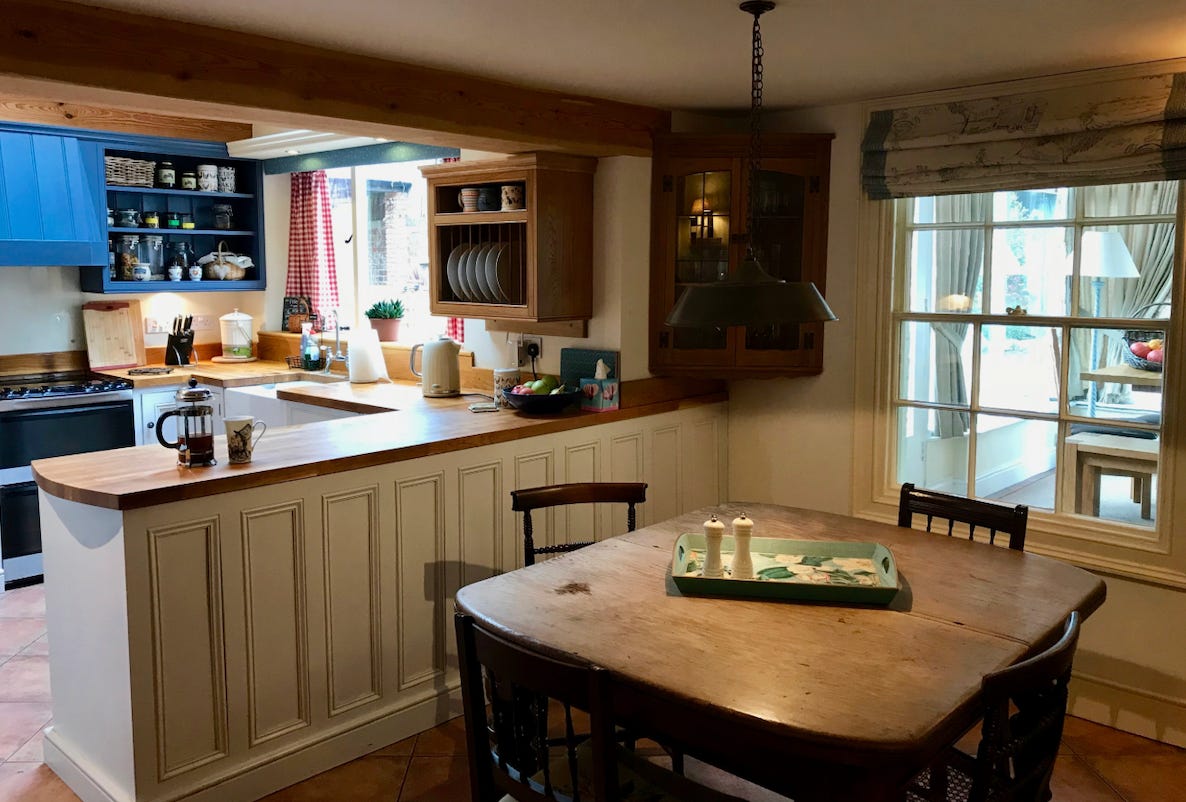
Karen got her carpenter to chop up the kitchen and reconfigure it so she could change the shape of the room. She then repainted the units dark green. Et voila - new kitchen!
There were other changes, which you can see – the wallpaper, the cooker and its previously vast hood and the sink (old butler’s sinks are a good timeless design and, as such, reasonably easy to sell or give away, repurposed, they also make pretty planters).
It sounds simple but don’t be fooled into blundering into this sort of project without design help of some sort, ideally someone as skilled as Karen, who’ll make sure all the small details are right and everything works and fits. There are also kitchen redesign companies who can help and I’ll return to them in more detail at a later date.
The resurrected sanitaryware
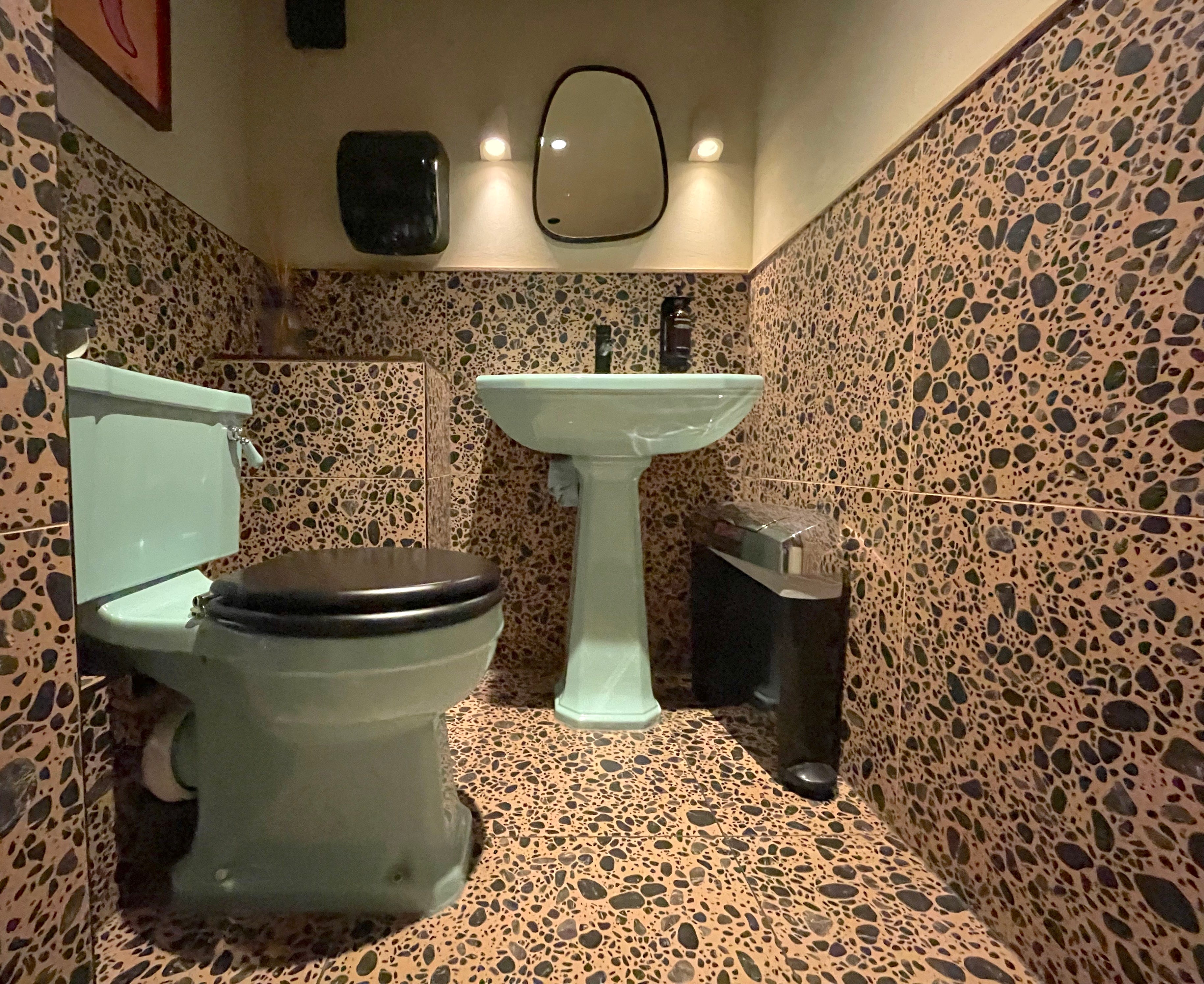
Love the (hesitate to use this word) ‘trend’ for reviving coloured bathroom suites. There was a big piece about it in the Observer a few months ago, and it’s something I’ve written about a few times in recent years because I love them. Spotted this blue duo in a restaurant this week looking lovely in a contemporary context and hoped it was original. Because, of course, you can now buy reproduction versions but originals can still be found. Broken Bog sells both (worth noting the website if you are trying to off-load a colourful suite, too, rare as they are these days).
When I think of reuse in the bathroom, I also default to the way my mum pulled off a cold lemon yellow bathroom suite we inherited soon after the look went out of fashion, and of which she was not fond.
Her trick was to ham it up, turning the entire surrounding room into an Art Deco-themed space with monochrome tiles, a black wooden loo seat and an antique chenille curtain. In that context, the lemon yellow looked entirely deliberate and kind of wonderful. When I went back to visit my childhood home a few years ago, of course it had all been ripped out. I like to think they got a good price for that rare citron sanitaryware.
The rubble garden
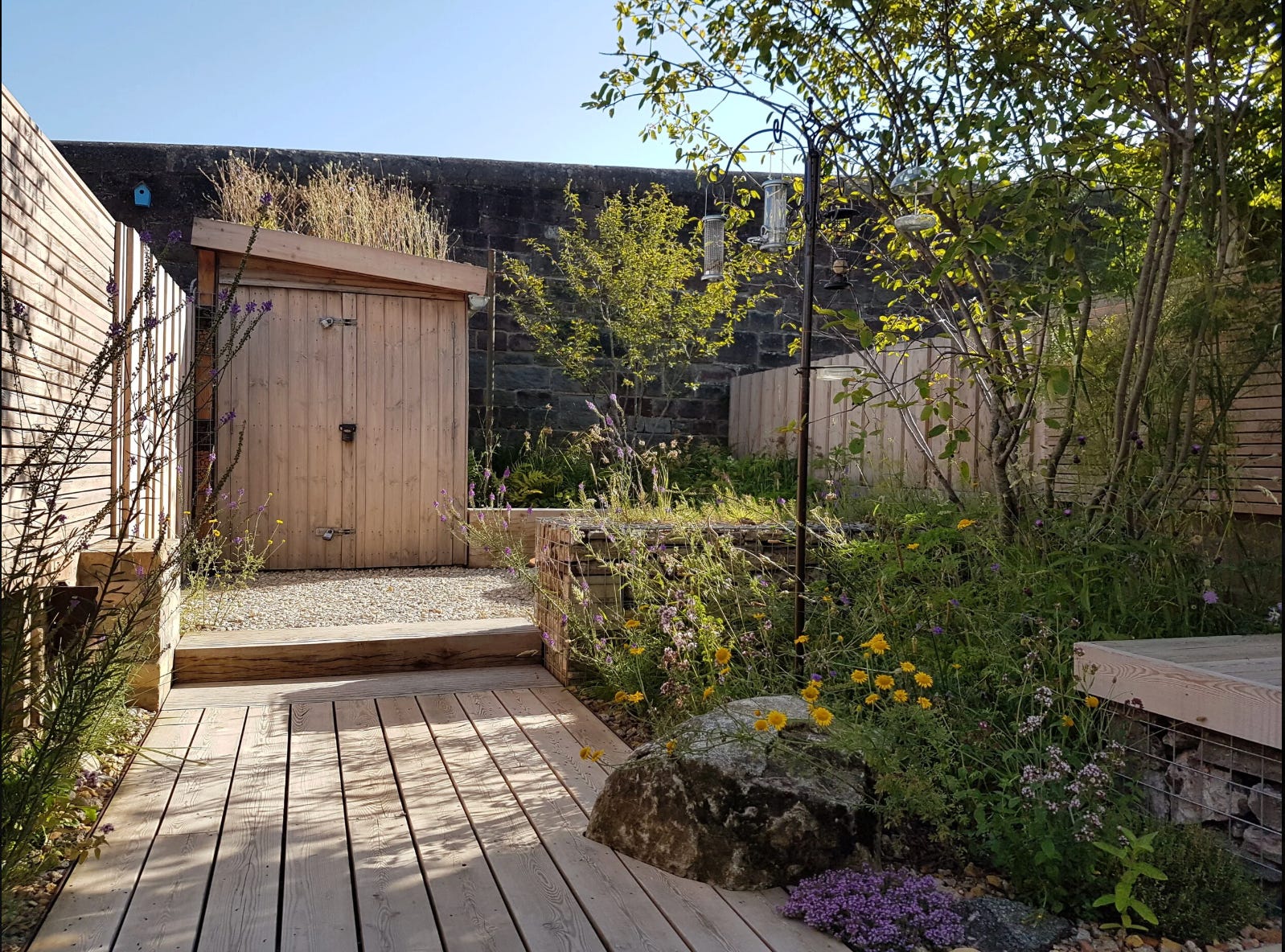
Landscape designer, Steve Williams, opened my eyes to a new way of creating outdoor spaces when I interviewed him and his business partner, Jon Davies, who together run Wild City Studio.
This new way? It’s called rubble gardening, sometimes also known as brownfield gardening and a key element is that it salvages waste materials to create wildlife-rich spaces. The idea comes from the pair’s observation that nature flourishes in apparently inhospitable locations such as motorway verges or stony urban brownfield sites, with hardy plants springing forth from aggregate rather than rich compost. There’s also inspiration in Beth Chatto and Derek Jarman’s famous gravel gardens.
How can this translate to the average private garden? With enough advance planning and early communication between whoever does your garden and your builders and architect if you’re using one, you can use, for example, bits of your demolished kitchen to create a garden as beautiful as the one pictured above – and given that between 100 and 200 million tonnes of construction industry waste is created annually in the UK, the possibilities of using some of this for gardens is full of potential.
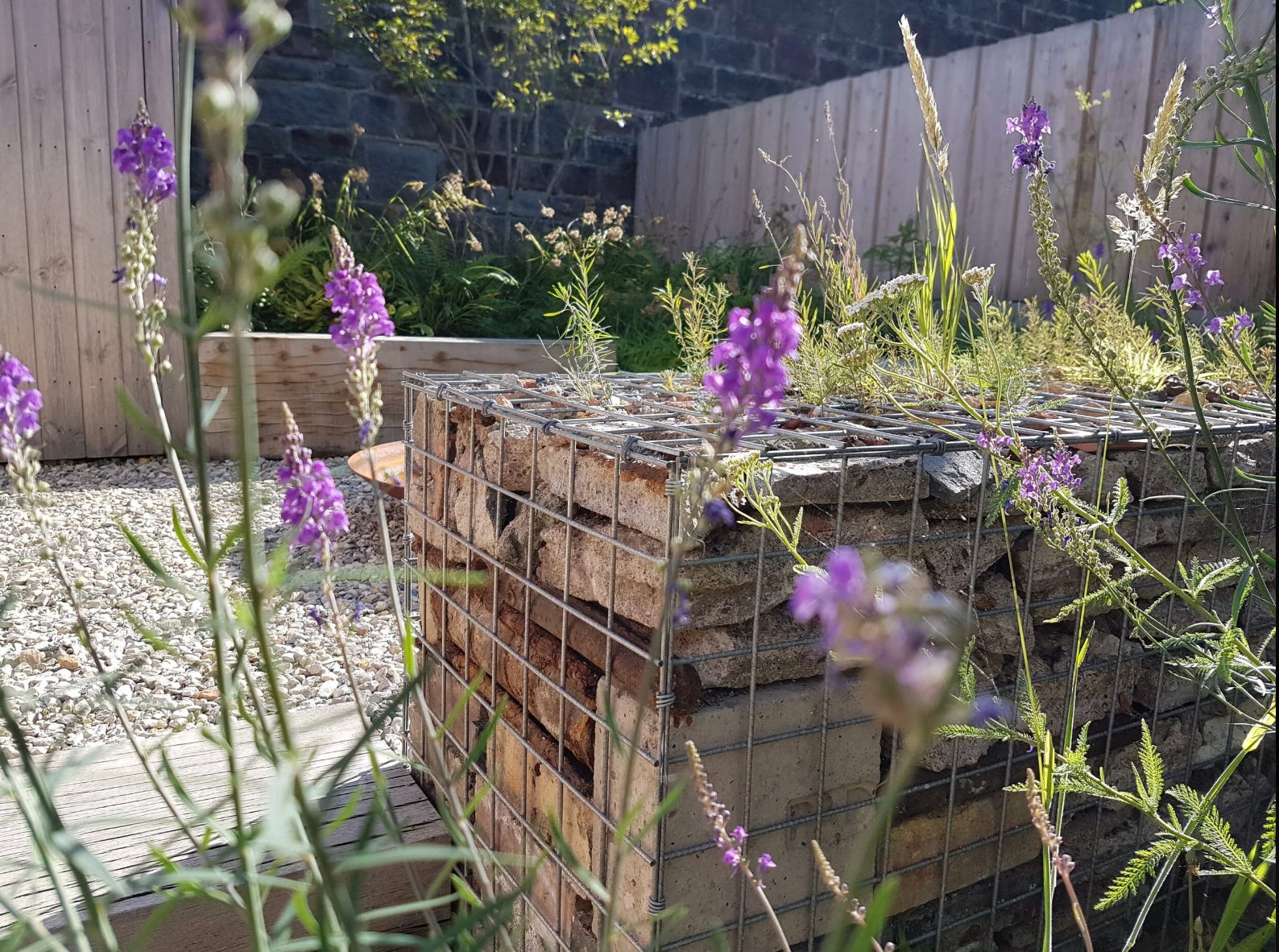
Of this example, Steve says: “We utilised a variety of reuse techniques from gabion features, log piles and brown roofs. We even crushed onsite materials to create different planting mediums for more diverse planting areas, including an edible meadow.”
The crevices between different sized rocks, gravel, dust and sand create habitats for a variety of invertebrates which, in turn, attract birds. The sorts of plants suited to this environment tend to be extremely hardly and able to withstand long dry spells.
Want to know more about this idea? Check out Nature Rising from the Rubble, the report by garden designer Sally Bower, which concludes that: “There seems to me to be enormous scope for this approach to be used at all scales to create planting schemes adapted to climate change for people and wildlife.”
Brilliant ideas, thanks for sharing.
This is so interesting! Our office is in the middle of a multiple-year refit (we're at least three years in and the builders have told me we've got another year to go) and I haven't seen any sign of reuse which is so sad. I love the idea of being able to reuse what's already there